RFID-метки для стирки

We manufacture textile RFID laundry tags, PPS laundry tags and UHF laundry labels in our own factory, and have done since 2013. Output runs at 30 million tags a month. Every tag is tested for chip function before it ships.

Показаны результаты 1–16 из 66.Сортировка: самые недавние

RFID Laundry Tag FAQs

Choosing an RFID laundry tag takes more than a wash cycle figure. The tag has to fit your textile, your attachment method, your reader and your full finishing line. The questions below answer each of those points with the figures we work to.

General Questions

What is an RFID laundry tag used for?

An RFID laundry tag carries a chip and antenna inside a textile, PPS or silicone body. It identifies a garment or linen item at a sorting station, tunnel exit or handheld check, so the same item can be counted, routed and traced through repeated wash cycles.

Which frequency should I use, UHF, HF or LF?

UHF RFID laundry tags cover 860–960 MHz and read furthest — over 12 meters on a square textile tag with a Chainway C72 in our own test, and 5 to 12 meters typical at customer sites depending on reader power and environment. HF runs at 13.56 MHz and suits close-range reads, including NFC phones. LF runs at 125 kHz and gives the shortest range. Pick the frequency your readers already support.

Can you encode the chips before shipment?

Yes, RFID tags can be encoded before shipment. UHF tags go to your EPC scheme, and HF or LF tags to your own data format. Send the file and the data structure, and we will confirm the write and lock settings before production.

Questions About Textile RFID Laundry Tags

What is a textile RFID laundry tag made of?

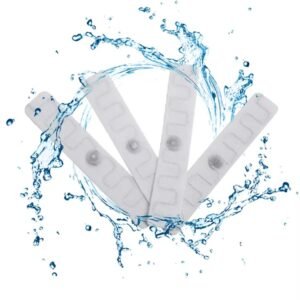
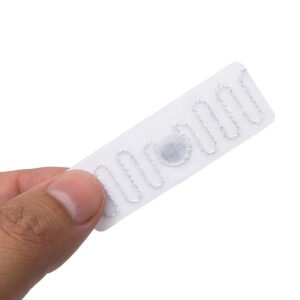
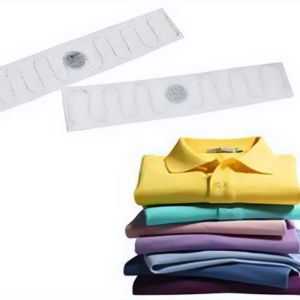
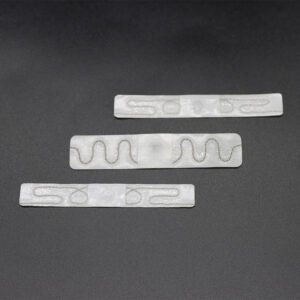
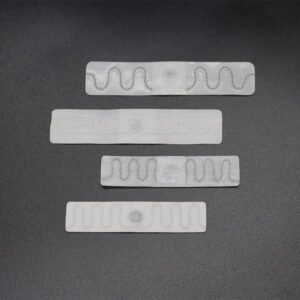
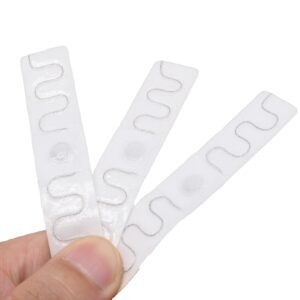
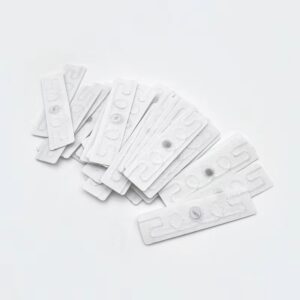
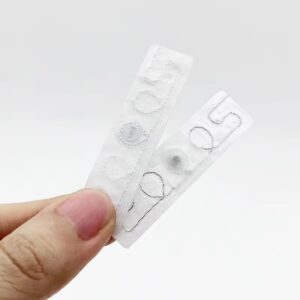
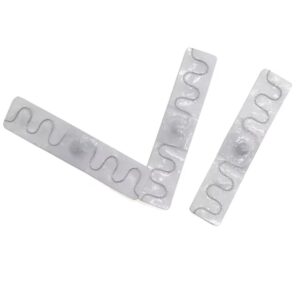
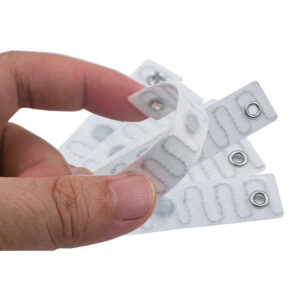
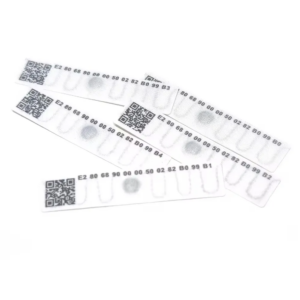
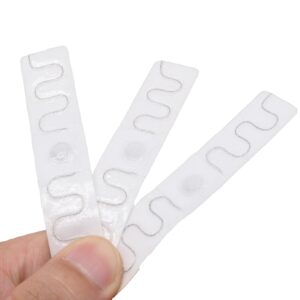
An RFID laundry tag is a textile body with the chip and antenna bonded inside and laminated on both faces. The finished tag stays flexible enough to sew into a hem and thin enough to sit flat against the fabric.

What wash conditions does a textile tag handle?

Test conditions for our textile RFID laundry tags — wash: 100 °C, 60 min; pressure resistance: 120 bar; water extraction: 60 bar; tunnel finishing: 185 °C, 30 min; steam sterilization: 134 °C, 20 min, 85% RH.

How many wash cycles does a textile tag last?

Our textile RFID laundry tags are rated for 200+ industrial wash cycles, and square tags have reached 300 cycles in testing. Cycle counts depend on wash chemistry, temperature and mechanical handling at your site, so treat this as a starting point rather than a fixed life.

How do I attach a textile tag?

Sew the RFID laundry tag into a hem, waistband or seam allowance, keeping the stitch line clear of the antenna. Heat sealing runs at 190–205 °C, setting 5–6, for 15–20 seconds; sealed this way, the bond typically survives around 200 wash cycles.

Which chips and sizes are standard?

UHF RFID laundry tags use NXP UCODE 9 or Alien Higgs-10 (H10) on EPC Class 1 Gen 2 (ISO/IEC 18000-63). Standard sizes are 38 × 20, 56 × 10, 60 × 20, 70 × 15 and 87 × 18 mm. Other sizes are available as custom orders (MOQ 500).

Questions About PPS RFID Laundry Tags

What is a PPS RFID laundry tag?

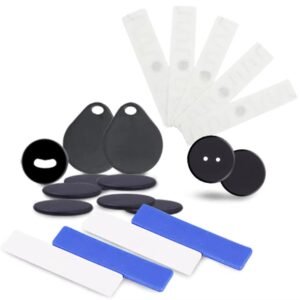
A PPS RFID laundry tag is a rigid disc molded from PPS around a chip and antenna. It is riveted, or bolted through a pre-drilled hole, onto a garment, a linen bag or a laundry cart, and it keeps its shape through repeated chemical exposure.

Which frequencies does a PPS RFID laundry tag support?

Standard stock PPS discs are HF 13.56 MHz (ISO 15693 / ICODE SLIX) and LF 125 kHz (TK4100 / T5577). UHF PPS discs are technically feasible but not our mainstream offering, available only as custom-engineered projects with higher MOQ. If your deployment uses UHF portal readers, our textile RFID laundry tag is the standard recommended solution.

What temperature can a PPS tag take?

PPS RFID laundry tags are rated from −25 to 110 °C. That covers standard wash and dry cycles but stops short of the 134 °C used in hospital steam sterilization.

Can a PPS tag go through a steam sterilizer?

No, a PPS RFID laundry tag cannot go through a steam sterilizer, because 134 °C runs above its 110 °C rating. For hospital textiles that pass through a sterilizer, use the textile tag, which is rated for 134 °C for 20 minutes at 85% relative humidity.

What sizes and MOQ does a PPS disc have?

PPS RFID laundry tag discs range from 14–30 mm in diameter, with MOQ 500 pieces. Read range is 1–5 cm, so a PPS disc suits a handheld or close-range reader rather than an overhead portal.

Questions About Silicone RFID Laundry Tags

When should I choose a silicone tag?

Silicone RFID laundry tags suit items where a soft edge is important, such as garments worn against the skin or linen that passes through a press. The molded body has no hard corner to catch on fabric.

Is silicone resistant to laundry chemicals?

The silicone body of an RFID laundry tag resists most wash chemistry. The limit sits in the chip and antenna inside it, so send your detergent type, concentration and temperature for a compatibility check before you commit to a specification.

Can silicone tags be laser marked or printed?

Yes, both laser marking and thermal printing work on the silicone surface of an RFID laundry tag. Send the artwork and the numbering rule, and we will confirm the marking method on the sample.

Questions About NFC RFID Laundry Tags

What is an NFC laundry tag?

An NFC laundry tag is an RFID tag that runs at 13.56 MHz and communicates with a phone or handheld reader held within a few centimeters. It is used where staff scan individual items rather than passing a whole batch through a portal.

Which chip do you use for NFC?

NTAG213 is the standard chip for NFC RFID laundry tags, and ICODE SLIX covers ISO 15693 applications that need a longer command set.

Can an NFC tag be read by a phone?

Yes, an RFID tag can be read by a phone when the phone supports NFC and the tag holds a standard NDEF record. We can write a URL, a serial number or a custom record before shipment.

Does NFC work with a tunnel reader?

NFC RFID tags read at close range, a few centimeters, so they do not suit an overhead portal that reads a batch at once. Use NFC where a person scans the item, and UHF where the reader sits at a tunnel or sorting gate.

Washing and Sterilization

Can these tags go through a tunnel finisher?

Textile RFID laundry tags are rated for 185 °C for 30 minutes in a tunnel finisher. PPS is limited to 110 °C, so a PPS disc does not go through the finisher.

Do the tags survive steam sterilization?

Textile RFID laundry tags are rated for 134 °C for 20 minutes at 85% relative humidity. PPS discs are not rated for it, because 134 °C sits above their 110 °C limit. Send your sterilization profile and we will confirm the part.

What chemicals do the tags resist?

Our RFID laundry tags withstand the detergents and alkalis used in industrial laundries. Chlorine bleach shortens service life on any tag, so tell us if your process uses it and we will adjust the recommendation.

Is there a test report for these conditions?

The wash, extraction, finishing and sterilization figures for our RFID laundry tags come from our own product specification and testing. We do not hold an ISO 15797 report, and we do not claim OEKO-TEX certification.

Customer Testing

How do customers test the tags before a rollout?

Most customers start with an RFID laundry tag sample batch run through their own line. We ask for wash temperature, cycle length, chemistry and finishing steps first, so the sample matches what production will run.

What should we record during the trial?

Record the wash program, the number of cycles, the read distance on your own reader, and any physical change to the RFID tag. Those four records decide whether the specification is right for the site.

Do you publish customer test results?

No. Test data belongs to the operator who generated it, and we do not publish it without written permission. We can describe the application type and the conditions that site ran, without naming it.

Can a customer test result be applied to my process?

No. A result covers the tag model and the conditions that site ran. Your textile, chemistry and reader setup will differ, which is why we recommend a trial on your own line before a bulk order.

Installation and Ordering

What information do you need for a quote?

To quote an RFID laundry tag we need seven points: tag type, size, chip, attachment method, wash temperature, cycle length and planned quantity. With those we can quote within one business hour (UTC+8).

What is the MOQ and lead time?

The MOQ for an RFID laundry tag is 500 pieces. Lead time: 1,000 pcs in 2 business days; 50,000 pcs in 8 business days; 100,000 pcs in 10 business days.

Are samples free?

RFID laundry tag samples are free of charge with a confirmed order. They are dispatched within 2 business days once the specification is agreed.

Can you print our logo or a serial number?

Yes. We laser-mark and thermal-print RFID tags in-house on textile, PPS and silicone. Send the artwork and the numbering rule, and we will confirm the layout on the sample.

Tell us your laundry process and we will match the tag, the chip and the attachment method for a trial.

Request a Sample for Your Process